
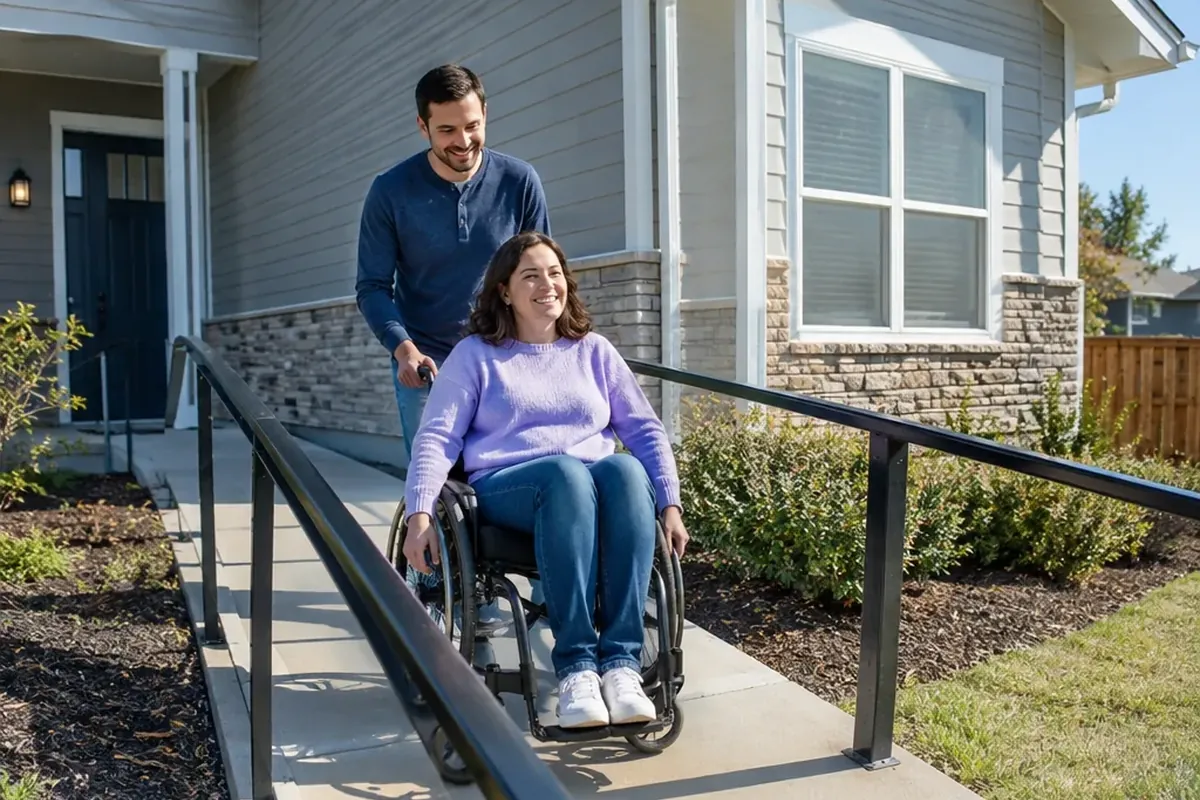
Yes, there are real grants to help disabled buy a home, but the money usually comes in layers rather than as one check. A first layer is a mortgage that counts your disability benefits as income, with as little as 0% down. On top of that you can add state down payment assistance that may be forgiven if you stay in the home, renovation loans that pay for ramps and wider doorways, and, for eligible veterans, grants of up to $126,526. Eighteen homebuying programs designed for people with disabilities and family caregivers offer between $2,000 and $117,000.
Grants to Help Disabled Buy a Home: What Actually Exists
Most help falls into four groups.
- Federal mortgage programs: FHA loans need as little as 3.5% down, HomeReady loans 3%, and VA and USDA loans 0%.
- Down payment and closing cost assistance: State housing finance agencies run programs for buyers with disabilities. Down Payment Resource tracks more than 2,300 state and local homebuyer assistance programs in its database.
- Veteran housing grants: The VA Specially Adapted Housing (SAH) grant pays up to $126,526 in FY 2026. The Special Housing Adaptation (SHA) grant pays up to $25,350. Both can go toward buying, building, or changing a permanent home.
- Nonprofit homeownership: Habitat for Humanity sells homes with an affordable mortgage to households earning no more than 60% of the area median income. Your monthly payment can’t be more than 30% of your gross monthly income.
The VA SAH grant has grown fast. It went from $90,364 in FY 2020 to $126,526 in FY 2026, a 40% rise in six years. You can use SAH and SHA grants up to six times in your life, and any amount you don’t use stays available for later years.
Why Buying Is Harder With a Disability, and Where to Find Support
The barriers are about money and about access. In 2023, about 35% of people with disabilities spent 30% or more of their income on housing. For people without disabilities, the share was about 25%. A 2024 study by the Technical Assistance Collaborative found that people who get SSI cannot afford a market-rate rental in any housing market in the US. The Federal Reserve’s 2024 survey on economic well-being found that adults with disabilities are less likely to own a home and more likely to rent. The Urban Institute describes millions of people with disabilities facing the worst housing crisis in a generation, with problems in affordability, accessibility, and a lack of integrated housing.
That is why accessibility matters before you buy, not just after. Changing a home later costs a lot. A full accessible bathroom remodel runs $9,000 to $40,000, while one grab bar costs $100 to $350. If you rent while you save, the Fair Housing Act lets you make structural changes to your unit and ask your landlord to adjust their rules. In federally assisted housing such as Section 8 and public housing, Section 504 of the Rehabilitation Act requires the landlord to pay for disability-related changes, unless doing so would be an undue hardship.
Practical and emotional support comes from about 400 Centers for Independent Living (CILs). These grew out of the independent living movement that began in Berkeley, California, in the early 1970s. Its core idea is that people with disabilities decide what support they need. CILs are free and funded under Title VII of the Rehabilitation Act through the Administration for Community Living, plus state money and grants. By law, most of each center’s board and staff must be people with disabilities. Every CIL must offer five core services:
- Information and referral
- Independent living skills training
- Peer counseling, where people with disabilities help each other from lived experience
- Individual and systems advocacy
- Transition services for young people leaving school, people moving out of nursing homes or institutions, and people at risk of being placed in one
CILs don’t provide housing themselves, but they help you find it.
How SSDI and SSI Count as Mortgage Income
Most lenders accept SSDI and SSI as reliable income for FHA, VA, USDA, and conventional mortgages. They count SSDI at its full amount. There is no reduction because it’s disability income. The details depend on the loan type:
- How long you’ve received it: Most conventional lenders want SSDI received for at least two years. FHA lenders often accept it after one year.
- How long it will continue: Following Fannie Mae and Freddie Mac guidelines, most conventional lenders want proof that SSDI will continue for at least three years from your application.
- Gross-up: Fannie Mae lets lenders “gross up” part of SSDI income. Up to 15% of the benefit can be increased by 25%. For example, $1,500 in monthly SSDI becomes $1,556 in qualifying income. This applies only to SSDI, which is earned through your work history. It does not apply to SSI, which is based on financial need.
Your main document is the Social Security award letter or Benefit Verification Letter. You can download it from your my Social Security account or ask for it at 1-800-772-1213.
Comparing Low-Down-Payment Mortgage Options
| Loan | Minimum down payment | Minimum credit score | Why it matters for buyers with disabilities |
|---|---|---|---|
| FHA | 3.5% | 580 | Accepts SSDI, SSI, and VA benefits; often counts SSDI after one year |
| VA | 0% | Not listed here | No VA funding fee for veterans with a service-connected disability |
| USDA Guaranteed | 0% | 640 | Household income up to 115% of area median; eligible rural areas only |
| USDA Direct | 0% | Not listed here | For incomes up to 80% of area median; payment subsidy and terms up to 38 years |
| Fannie Mae HomeReady | 3% | Conventional loans typically 620–640 | Allows a gifted down payment and a co-borrower who doesn’t live in the home, such as a parent or sibling |
| FHA 203(k) | FHA terms | FHA terms | Finances renovations, including accessibility changes |
HomeReady’s co-borrower rule helps if your own income is limited. A family member can add their income to your application without moving in.
Payment Assistance Programs Built for Buyers With Disabilities
Several programs are written specifically for buyers with disabilities.
- South Carolina, Families With Disabilities Homebuyer Program: An FHA, VA, or USDA loan at a reduced fixed rate, plus down payment help as a 0% second mortgage with a 15-year term. The second mortgage is forgiven as long as you stay in the home. The purchase price limit is $450,000.
- Maryland, HomeAbility Loan: A 0% second loan of up to 25% of the purchase price, capped at $45,000. You don’t repay it until you sell, refinance, or transfer the home. Household income must be at or below 80% of area median, and a doctor’s statement or benefits letter proves disability.
- Pennsylvania, PHFA ACCESS programs: The ACCESS Home Modification Program offers a 0% loan of $1,000 to $10,000 for disability-related changes, paired with a PHFA first mortgage. Buyers who use it can also get up to $15,000 in ACCESS Downpayment and Closing Cost Assistance.
Federal housing assistance can also go toward ownership. The HUD Housing Choice Voucher (Section 8) Homeownership program lets eligible voucher holders use their voucher toward buying a home, and the family pays about 30% of its adjusted income for housing costs. Public Housing Authorities (PHAs) choose whether to offer it. In 2024 and 2025, HUD paid PHAs a one-time fee of $1,500 for each homeownership closing and $2,500 for each new program they started.
Paying for Accessibility: Ramps, Doorways and Renovation Loans
Typical costs are $1,121 to $3,596 for a built-in wheelchair ramp and $3,000 to $15,000 for a stairlift. These funding sources can cover the work:
- FHA 203(k) Limited: Up to $75,000 for non-structural repairs and accessibility changes. The limit used to be $35,000.
- FHA 203(k) Standard: No cap on renovation costs, including accessibility changes.
- Medicaid HCBS waivers (Section 1915(c)): The largest public source of money for disability-related home changes. 46 states plus Washington, D.C., run more than 250 of these waivers (as of March 2025).
- VA Temporary Residence Adaptation (TRA) grant: Up to $50,961 for veterans eligible for SAH, or $9,100 for those eligible for SHA, for a temporary living situation.
- USDA Section 504 Home Repair grant: Up to $10,000 ($15,000 in disaster areas) for homeowners age 62 and older who can’t repay a loan.
Nonprofits help too. In its 2025 grant cycle, the Christopher & Dana Reeve Foundation gave $1.1 million in 56 Direct Effect grants to organizations serving people with paralysis. The National Disability Institute works to expand financial options for people with disabilities and refers people to assistive technology financing programs.
Common Myths About Disability and Homeownership
- “Habitat for Humanity gives away free houses.” Habitat buyers pay an affordable mortgage and put in “sweat equity” by helping build or volunteering.
- “HUD Section 811 helps me buy.” Section 811 funds affordable rental housing with support services for adults with disabilities who have very low incomes. It is not a purchase program.
How to Apply, Step by Step, and Find Programs Near You
- Call a HUD-approved housing counselor at 1-800-569-4287. Counseling is free.
- Check your credit: 580 for FHA, 620–640 for conventional loans, 640 for USDA Guaranteed.
- Gather proof of income: your SSDI award letter, bank statements from the last 2–3 months, and tax returns.
- Contact your State Housing Finance Agency and ask about programs for buyers with disabilities.
- Find a lender experienced with FHA 203(k) if the home needs changes. Submit a renovation plan with a contractor’s bid.
- Apply to your local Habitat for Humanity affiliate if your income is at or below 60% of area median. Be ready to show housing need and to complete sweat equity hours.
- Apply for VA grants online at VA.gov or by calling 1-800-827-1000.
To find local help, search the Down Payment Resource database by state and county. You can also use HUD’s state-by-state housing resource list, ask your local PHA whether it runs HCV Homeownership, and find your nearest CIL in the national directory kept by ILRU (Independent Living Research Utilization) in Houston.
Frequently Asked Questions
Can people with disabilities get grants or home loans to buy a house?
Yes. FHA, VA, USDA, and HomeReady loans accept disability income and need 0% to 3.5% down. Some state programs add down payment loans that may be forgiven, and eligible veterans can get VA grants of up to $126,526.
Can Social Security disability benefits count as income when applying for a mortgage?
Yes. Most lenders count SSDI and SSI. Conventional lenders usually want two years of SSDI history and proof it will continue for three years. FHA lenders often accept one year.
Are there grants to help disabled buy a home near me?
Possibly. Eighteen disability-focused programs operate in eight states and D.C., and the Down Payment Resource database lists more than 2,300 state and local programs. Your State Housing Finance Agency, local PHA, and nearest CIL can tell you what’s available where you live.
How can we help a disabled person emotionally?
Connect them with peer counseling at a Center for Independent Living. Counselors there have disabilities themselves, the service is free, and CILs also guide people through big moves, such as leaving a nursing home.
What are the main barriers to independent living?
Cost and access. About 35% of people with disabilities spend 30% or more of their income on housing, people who get SSI can’t afford market rent anywhere in the US, and accessible homes are hard to find.